Teaching a network to think longer
My CS440 project asked whether a recursive network can stand in for search. It learned to think in steps. It did not learn when to stop. You can play it below.
On this page
The model you can play at the bottom of this post thinks before it moves. Each step it refines its answer, and a small head decides when the answer is good enough. How long it thinks is its own call.
Getting it to use those steps at all took three attempts. Getting it to spend more of them on harder positions is the part I haven’t solved.
This was my final project for CS440. The code, the data and every number below are in CS440-Final-Project.
The question
Game-playing agents like AlphaZero pair a neural network with tree search. The network says which moves look good; the search checks by playing them out. The search is what makes them strong, and it’s also what makes them expensive.
A transformer already looks at every square of the board at once, so it has breadth for free. What a fixed stack of layers doesn’t have is depth: it can only take as many dependent reasoning steps as it has layers. Search supplies that depth by going one move further down the tree, then another.
Recursive models like TRM take a different route. They reuse one small network over and over, updating a latent state of the whole board each time. Each pass is something like one round of value iteration over every square at once. So the hypothesis was:
A weight-tied recursive network does something like search in latent space, and the number of steps it needs grows with how far ahead the position requires you to look.
Why Connect Four
Because it’s solved. Pascal Pons’ solver gives the exact value of every move in every position, so I never have to guess whether the model was right.
From the solver’s scores I built a label for how hard a position is: r, the required lookahead. It is the smallest search depth that proves the best move beats every other move. A position with r = 1 is “win now”. A position with r = 9 needs nine plies of lookahead before the winning move separates from the rest. The label is checked against a brute-force search in the tests: a depth-k search goes from chance to 100% exactly at k = r.
The test set is 12,991 positions from solver-played games, each with exactly one winning move, balanced by r and by game stage so that “hard” doesn’t just mean “late in the game”. I’ll call it the tactical set.
Attempt one: it answered in one step
The first models were TRMs trained the standard way: each step runs the network 42 times, gets graded on its own, and hands its state to the next step with the gradient cut. They were good. The best one picked the optimal move 89.7% of the time, with a quarter of the parameters of a plain 8-layer transformer that scored 84.1%.
But it got 89.8% after one step and 89.7% after sixteen. The learned stop head stopped at step 1 on almost every position. Running extra recursion at test time moved accuracy by about a point, the same at every depth. A run that forced 32 steps on every position learned too slowly to pass its go/no-go check and was stopped at 60,000 updates.
The models that learned well did it in one step. Looking back, the training made that the only sensible thing to do:
| What the training did | Effect |
|---|---|
| Each step was 42 layer passes deep | One step already solved what the model could solve |
| The gradient was cut between steps | A step was never rewarded for setting up a later one |
| Only the single best move counted | Half-finished lookahead earned nothing |
Attempt two: put the thinking in the outer loop
So I changed all three.
- Shallow steps. One step is now 4 layer passes, not 42. The model gets up to 24 of them, 96 passes in all.
- Credit across steps. The state is never detached, so the learning signal flows back through every step. A step can be rewarded for helping a later one.
- A halting-weighted loss, after PonderNet. The stop head gives the chance of stopping at each step. The loss grades each step’s answer weighted by the chance the model stops there, plus a penalty that keeps the expected number of steps near 6.
- Partial credit. A new head predicts, for every column, what playing it leads to: win or loss, and roughly how soon. The model can get the easy columns right before the hard ones.
Running the gradient through 24 steps would need about 870 MB per step on a
batch of 128. Recomputing each step on the backward pass instead of storing it
brought that to 13 MB, so memory stopped deciding the design. torch.compile
plus fp16 made training 1.57× faster, measured with
neural-cost. Every run trained for 22,000
updates of 128 positions on two Macs at home.
It learned to think
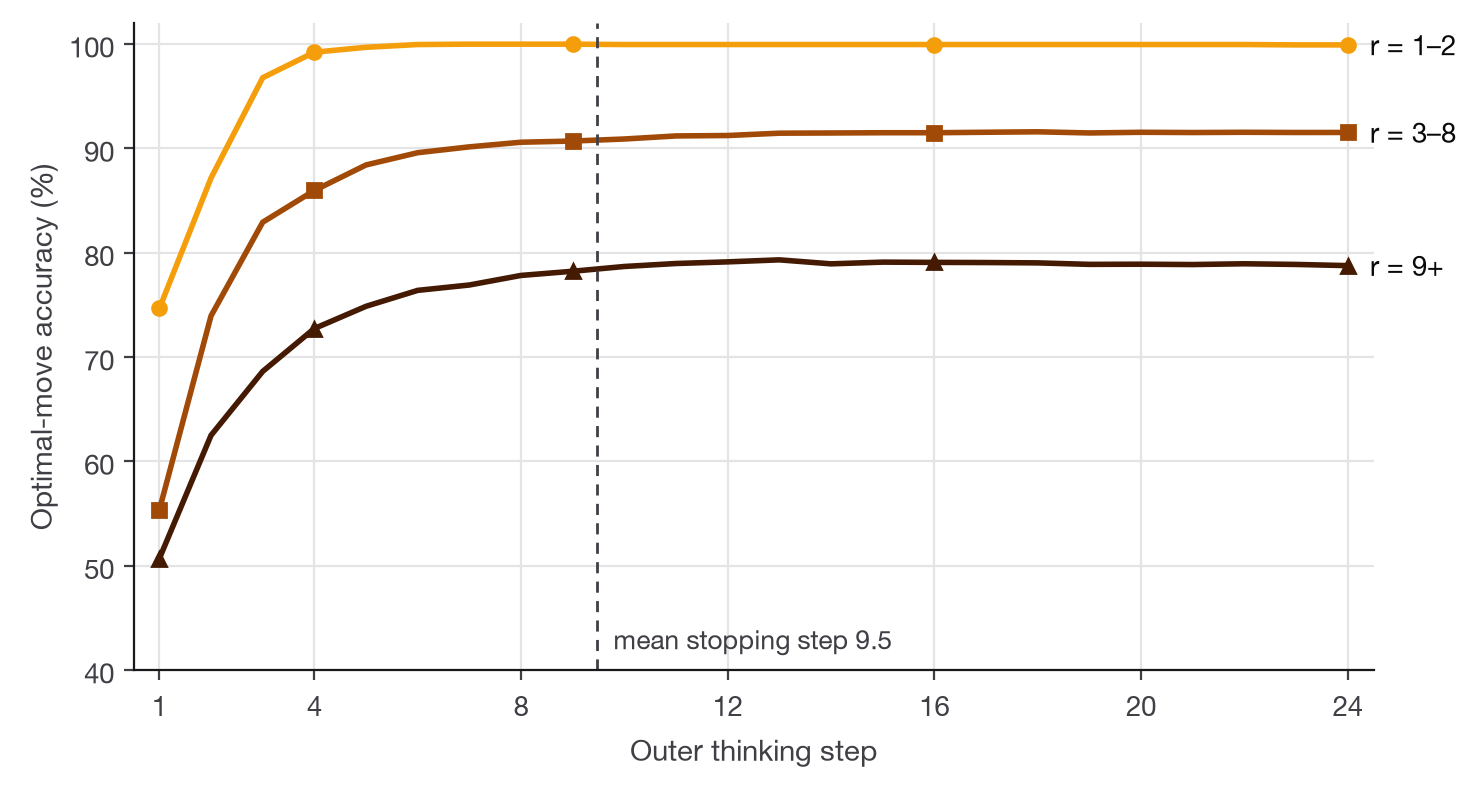
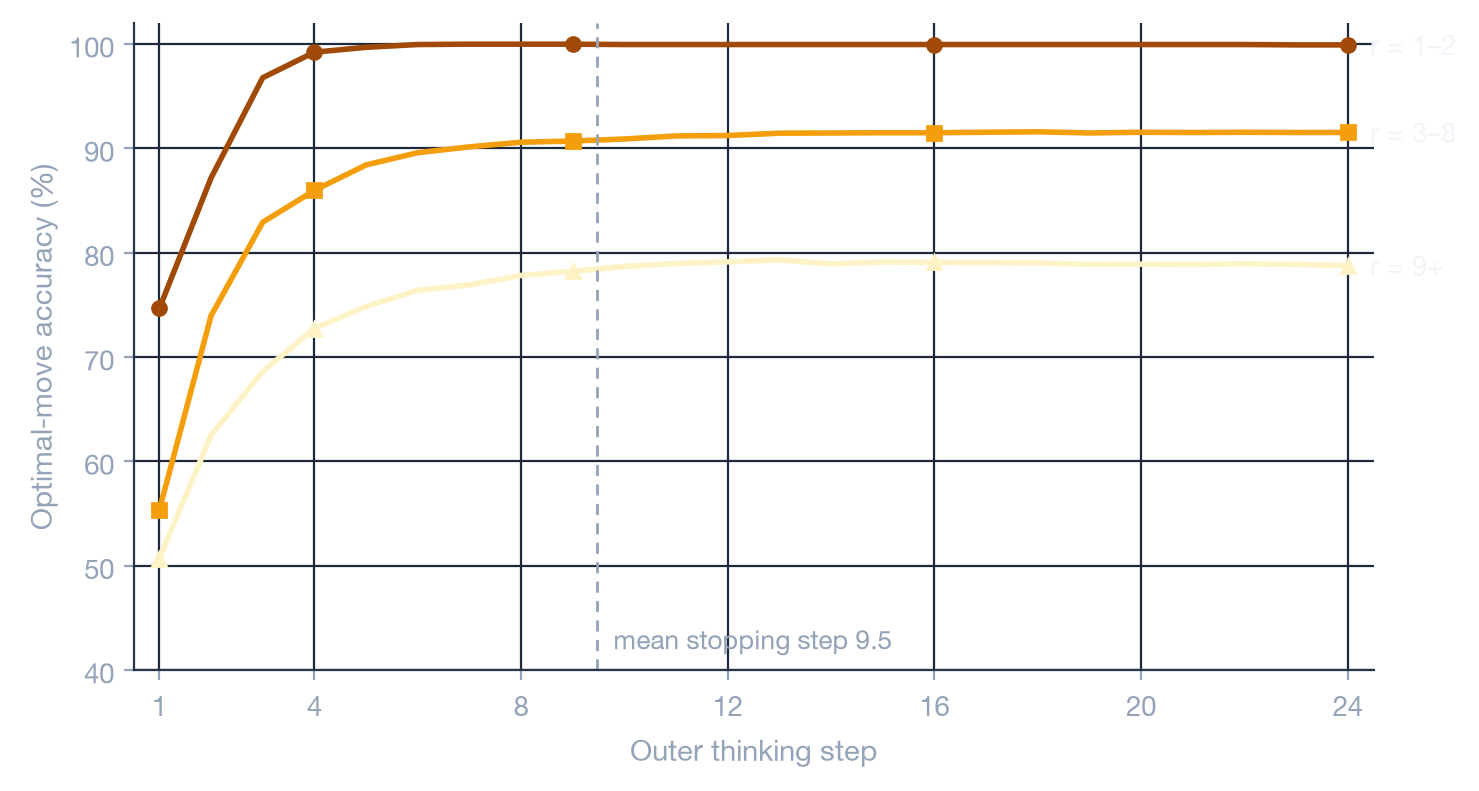
This is the curve that had been flat in every earlier model. The best model gets 57.9% at step 1 and 88.1% at the step it chooses to stop on, about step 9.5. On the hardest positions, r = 9 and up, it goes from 50% to 78%. The steps are now doing real work.
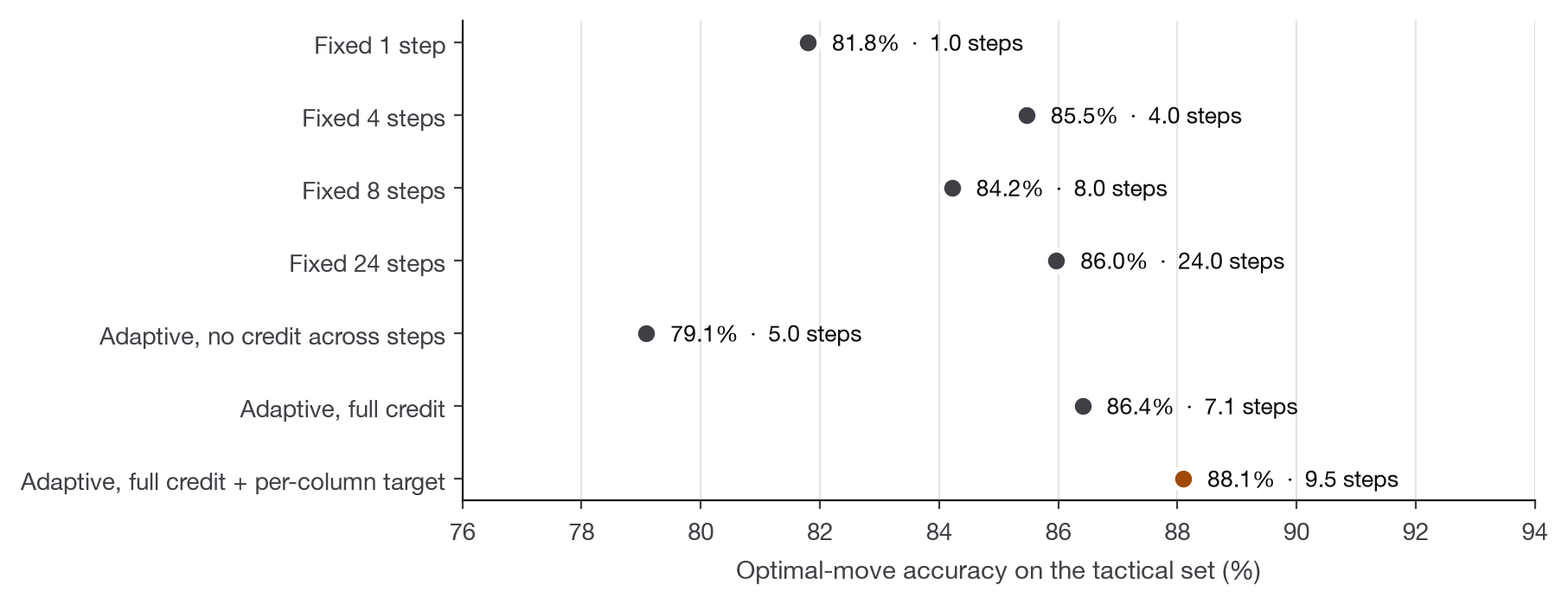
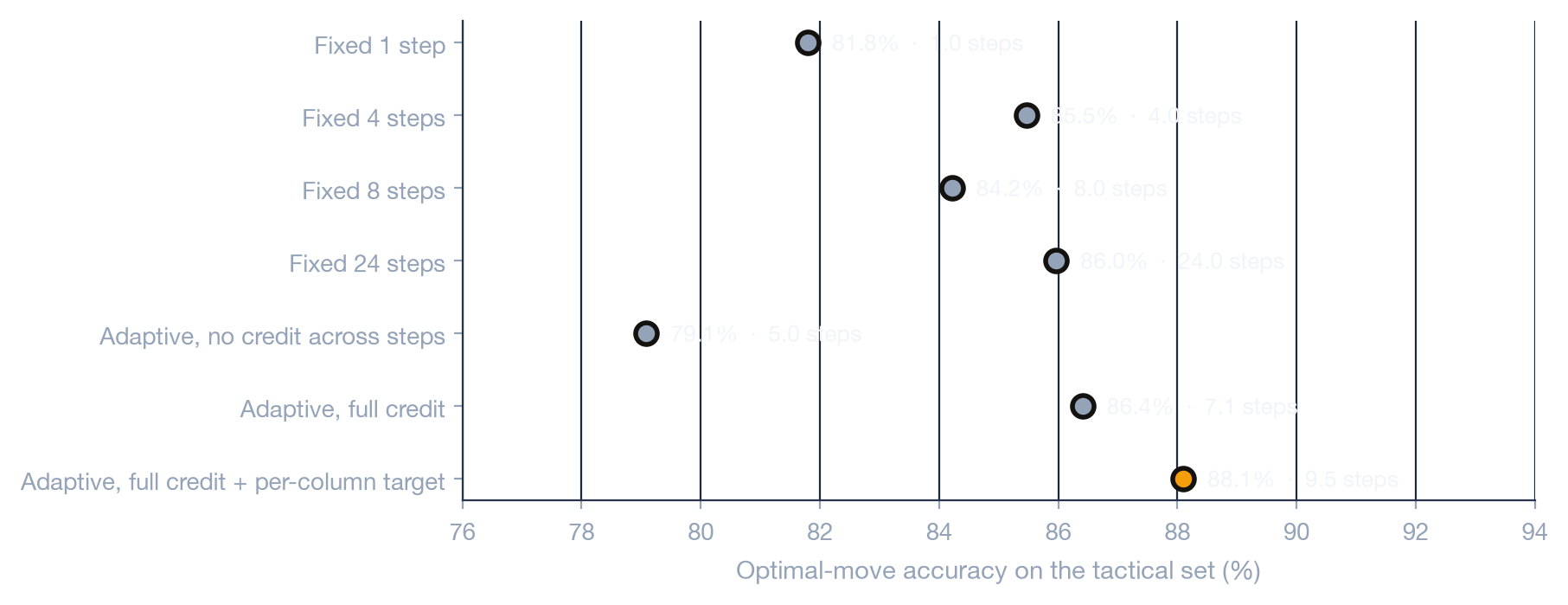
The ablations say which change mattered. Cutting the gradient between steps (the old setup, with everything else new) gives 79.1%, worse than a model trained to answer in a single step. Letting credit flow across steps gives 86.4%. The per-column target adds another 1.7 points. Models trained to always take a fixed number of steps top out at 86.0%, and that one needs all 24.
In a round-robin of 101,880 games from 1,415 openings, this model finished top of the field at 1546 Elo. The perfect solver sat at 1726, and the model took 23% of the points against it.
It didn’t learn when to stop
Here is the part that didn’t work.
If the network were doing something like search, positions that need more lookahead should get more steps. They barely do:
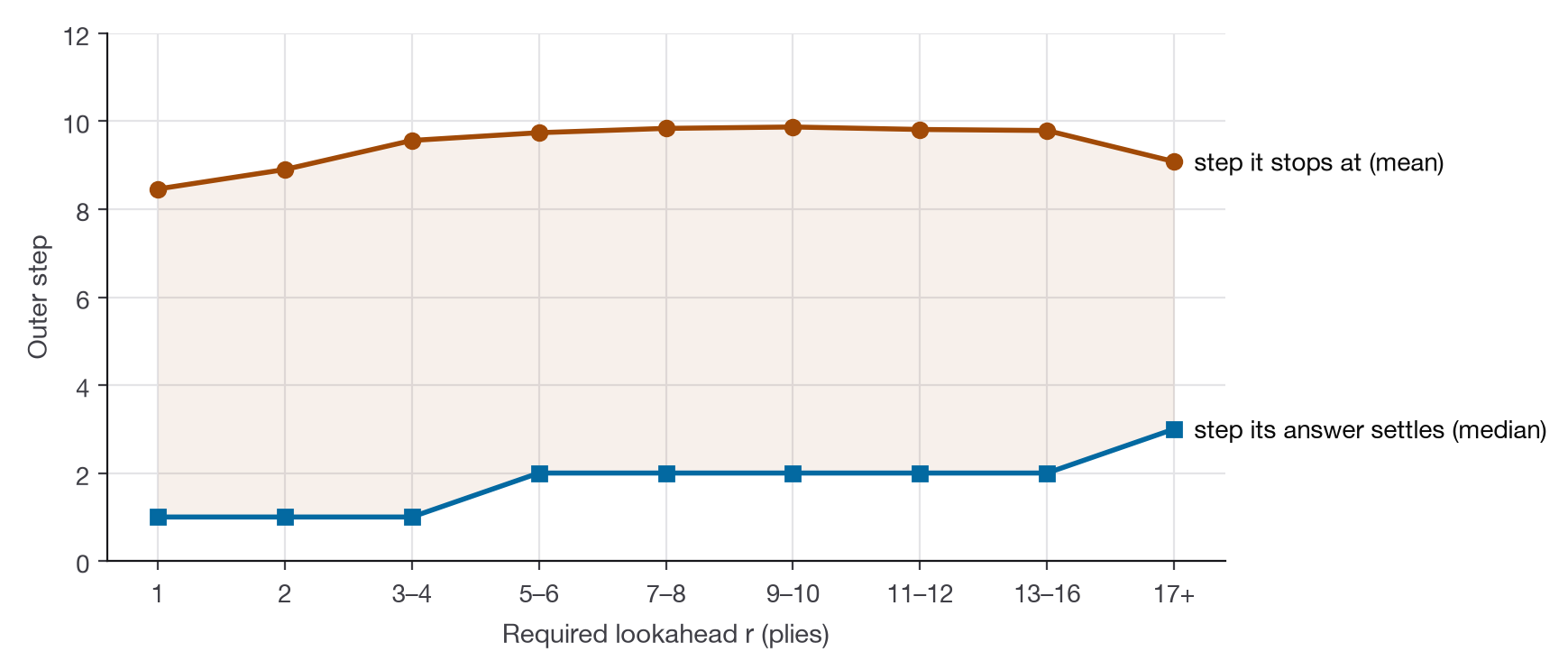
It stops at step 8.5 on r = 1 positions and about 9.8 on everything from r = 5 to r = 16. The correlation between stopping step and r, measured within each game stage, is 0.25. That clears the bar I set for the pilot (0.1) and misses the one I set for success before running anything (0.3 in every stage).
The blue line is the giveaway. On a typical position the model’s answer has settled by step 1, 2 or 3, and then it keeps thinking for another six or seven steps anyway. It overthinks easy positions and leaves almost no slack on the hardest ones.
A model that always stopped at step 9 would score 87.8%, 0.3 points behind the adaptive one. On the second training seed the difference is zero. If you could stop each position at its best step, you’d get 94.8%. That gap of 6.7 points is what a good stop rule is worth, and this one isn’t capturing it.
So the honest summary: the network learned to use thinking steps, and they buy a lot of accuracy. It did not learn to spend them where they’re needed. The depth hypothesis is still neither confirmed nor ruled out.
Play it
This is the same checkpoint, running in your browser.
Loading the model…
1.25M parametersNo searchRuns on your device
What you’re looking at:
- The bars over the board are its move head after each step: how much it likes each column right now. Early steps are often wrong; watch for the step where it changes its mind.
- The ring fills with its readiness to stop. It plays when the ring closes, and the number inside is the step it’s on. It tends to think longest in the middle of the game, about 10.4 steps around move 24 against 8 on the first.
- The dots mark the empty holes where its internal state moved most in that step. It’s a rough picture of where the update is happening, not an explanation of why.
There is no ML runtime here. The network is 1.25M parameters, exported to a 2.5 MB file of 16-bit floats and run in about 250 lines of TypeScript in a Web Worker. Rounding the weights to fp16 changed none of its moves on 2,000 tactical positions, and a check script compares the browser port’s outputs to PyTorch’s at every step; they agree to within 0.000003. One step takes about a tenth of a second on a laptop, so a move takes about a second, and what you see is the real pace.
It’s a strong player for a model that never looks a single move ahead, and a weak one next to the solver. You can beat it.
What I’d try next
The stop head is trained only through the halting-weighted loss, which pays it for stopping when the answer is good but doesn’t make stopping later costly enough on easy positions. The next thing I’d try is giving it a direct target: the first step after which the answer stops changing. Then I’d run more seeds, because a 0.3-point edge on one seed and zero on the other isn’t a result yet.