Skip to content
All work

Moving three toolchain apps to Kubernetes on Azure

Three toolchain applications moved to Kubernetes on Azure, deployed one way with Helm and infrastructure-as-code, and secured with an Istio service mesh.

Type
Professional
Year
2025 — present
Built with
Kubernetes · Azure · Istio · Helm · Infrastructure-as-code
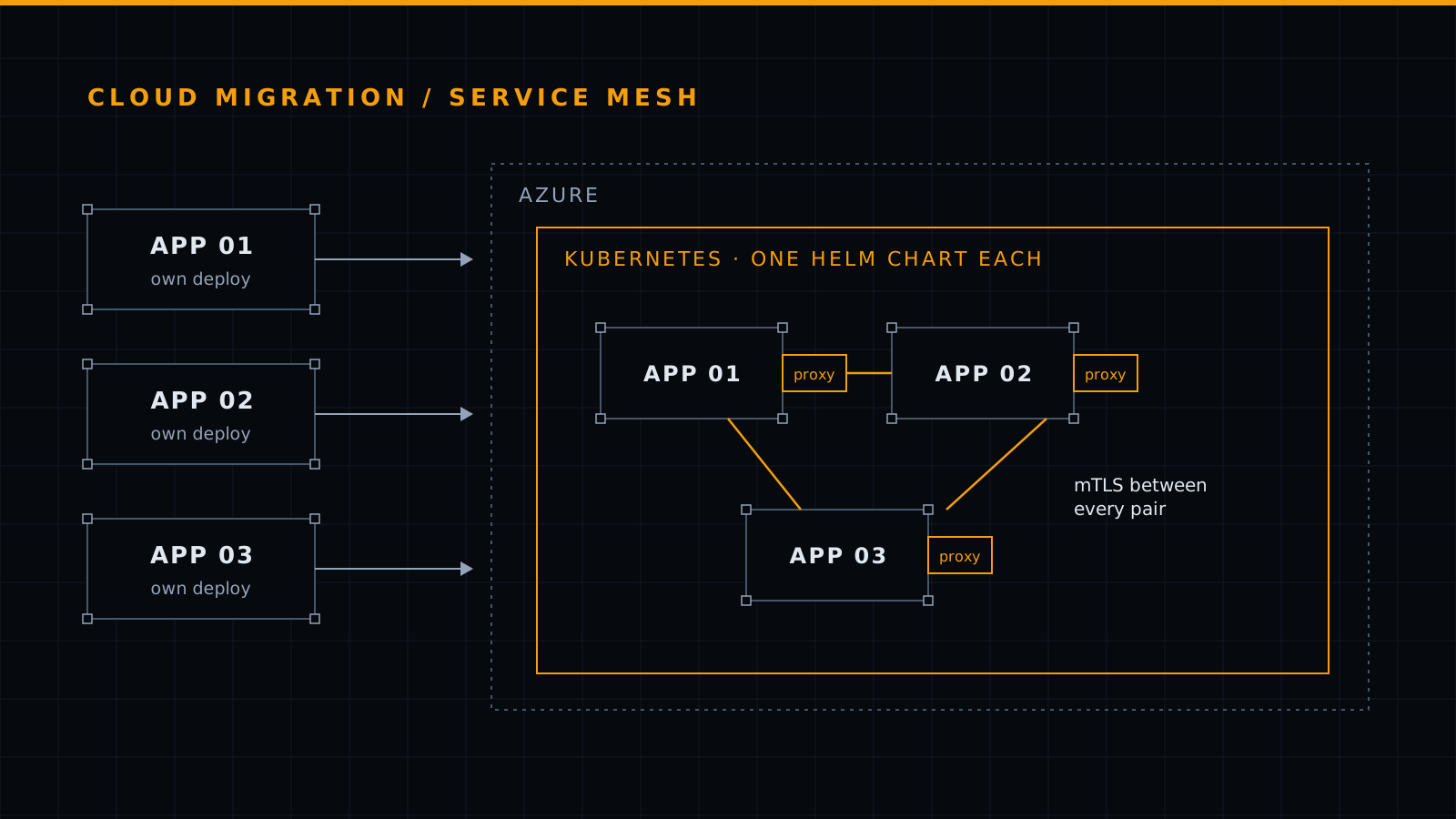
Diagram of three applications moving into a Kubernetes cluster on Azure, each running beside a service-mesh sidecar, with encrypted links between them.

Three software toolchain applications, each deployed its own way, needed to move to the cloud. Moving them was only half the job. Afterwards they had to be deployed the same way, talk to each other securely, and stand up in front of a customer in a live demo that fed into a $90M contract award.

One way to deploy

The first decision was that none of the three would keep its own deployment story. Every application ships as a Helm chart (configuration-as-code), and the Azure resources underneath are infrastructure-as-code. The win from that is dull and large: a fourth application is a chart and a pull request, not a project.

It also turned the migration into a reviewable change. When the whole deployment is text in a repository, a security review is a code review, and “what changed between Tuesday and Wednesday” has an exact answer.

A mesh, for identity

Inside the cluster, the applications talk through an Istio service mesh that I configured and operate. The mesh is there for one main reason: service-to-service traffic is mutually authenticated and encrypted without any of the three applications having to implement it. A service’s identity comes from the platform, so policy can say which service may call which, and the network location of a pod stops being a credential.

The cost is real. A mesh is another control plane to upgrade, another set of proxies to debug, and a new way for a misconfiguration to break everything at once. For three applications that previously trusted the network, I think it was the right trade, but it is a trade.

The demo

Live demos are their own kind of production. The migrated applications were shown working in the cloud as part of the pursuit, and that demo directly contributed to securing the company’s share of a $90M award. It is the only deployment I’ve done where the audience was the acceptance test.

Program details are omitted. The engineering is the interesting part anyway.

Let's connect

Have something hard that has to work?

Contract work, a full-time role, or a problem you want a second opinion on — I read every message and reply to the ones that aren't a template.

Email me

Usually replies within a day or two · St. Louis, Missouri

ESC

Home

Main landing page & highlights

Page

Work

All engineering projects & case studies

Page

Writing

Technical notes & engineering articles

Page

About

Background, career timeline & skills

Page

Contact

Email, inquiries & consultation

Page

Copy Email Address

davidgraymi@gmail.com

Action

Toggle Light / Dark Theme

Switch color theme

Action

Résumé

Web page, with a PDF download

Read

Play Wordlet

Launch the Flutter word puzzle in browser

Game

Visit GitHub

github.com/davidgraymi

External

Visit LinkedIn

linkedin.com/in/david-gray-mi

External

Threat modeling a zero-trust deployment pipeline

A continuous deployment pipeline for configuration-as-code and infrastructure-as-code into Kubernetes, designed from its threat model outward so the release process does the security review.

Professional

Moving three toolchain apps to Kubernetes on Azure

Three toolchain applications moved to Kubernetes on Azure, deployed one way with Helm and infrastructure-as-code, and secured with an Istio service mesh.

Professional

A processor built from the ground up

Kernel, task scheduler and communication protocol written from nothing, in C and Ada, now in production and distributed globally.

Professional

Sign Language Interpretation System

Control any smart device with American Sign Language — hand tracking, a gesture classifier and grammar correction, wired together over a client-server link.

Capstone

A system library that runs anywhere

One portable C++ library targeting any RTOS or bare-metal system, packaged with Docker, Bazel and GitLab CI — cutting porting work by 4×.

Professional

LaCam for Multi-Agent Path Finding

A from-scratch LaCam solver for CS440 — agents searching a space of joint configurations, each expanded by a constraint tree that rules out collisions and swaps.

School

Patient Care Portal Triage

An NLP pipeline that routes patient portal messages to the right team and surfaces relevant evidence-based research while they wait for a human.

Research

Bindersnap

GitHub for everyone who doesn't use GitHub — document management, review lifecycle, team collaboration, search and an in-browser editor.

Personal

Wordlet

A word guessing game built in Flutter and compiled to the web — playable right here, no install, no account.

Personal

Reinforcement Learning applied to Tetris

An agent that learns to play Tetris — a genuinely fun excuse to get hands-on with reward shaping.

School

Handwritten digit recognition with weighted KNN

A KNN classifier for handwritten digits, plus a k-value optimizer that collapses repeated distance calculations into a single pass.

School

ID3 mushroom classification

A from-scratch ID3 decision tree that predicts whether a mushroom is edible or poisonous from its attributes.

School

Healthcare length-of-stay estimator

A data mining project predicting how long a patient will stay, from admission-time features.

School

This website

A static site built with Astro, hosted free on GitHub Pages, designed so writing a post costs one markdown file and nothing else.

Personal

An Unexpected Email, REPRO-SIGN, and 11 Citations on Google Scholar

Years after our college capstone, an out-of-the-blue email from European AI researchers wanting to reproduce our sign language paper sent me to Google Scholar, where we've been cited 11 times.

Post

Connecting the Dots: How a Sign Language Capstone Got Me Hooked on AI

Looking back at my senior capstone project at Missouri State — building a real-time American Sign Language smart home controller with MediaPipe, custom CNNs, and networking — and how it sparked my path in machine learning.

Post

GPU vs. CPU: Roofline Benchmarks on Apple Silicon MPS with neural-cost v0.2.0

The neural-cost v0.2.0 GPU benchmark moves from CPU roofline analysis to Apple Silicon's MPS GPU backend — measuring PyTorch and JAX across five architectures, four batch sizes, and both eager and compiled execution modes.

Post

PyTorch vs. JAX vs. TensorFlow: A Roofline Benchmark Across 5 Architectures

An empirical investigation comparing PyTorch 2.14, JAX 0.11, and TensorFlow across five model architectures and four batch sizes, measuring compiler speedups, kernel overheads, and hardware limits on Apple Silicon.

Post

neural-cost: Roofline Analysis Across PyTorch, JAX, and TensorFlow

A framework-neutral Python library that estimates a neural network's FLOPs and tensor traffic, measures its runtime, and uses a roofline model to tell you exactly where performance is being left on the table.

Post

I rebuilt this site so that publishing costs one file

The old site was a single 41,000-character index.html. Every change was archaeology. Here is what I replaced it with and why the constraint was maintenance, not design.

Post
↑ ↓ to navigate↵ to select
esc to close